






Project description
Our goal, is to create an intelligent, self-sustainable irrigation system that optimizes water use for food production in dry regions like the Alentejo (Iberian Peninsula). Combining sensor technology, renewable energy, and data science with an educational, multi-disciplinary approach, the project serves as a living lab where students, researchers, and communities co-develop scalable solutions for sustainable agriculture and rural innovation.
The project we are working on is called SASIME: System for Autonomous and Smart Irrigation in Mixed-crop Environments. It's key features are:
- Precision Irrigation: Flexible nozzles deliver water directly to each section, ensuring optimal hydration for every plant, in a mixed crop biodiverse environment.
- Adaptive Intelligence: Algorithm adjusts irrigation to the unique and changing water needs of mixed crops.
- Smart Data Integration: Combines real-time soil humidity and live weather data to optimize timing and efficiency.
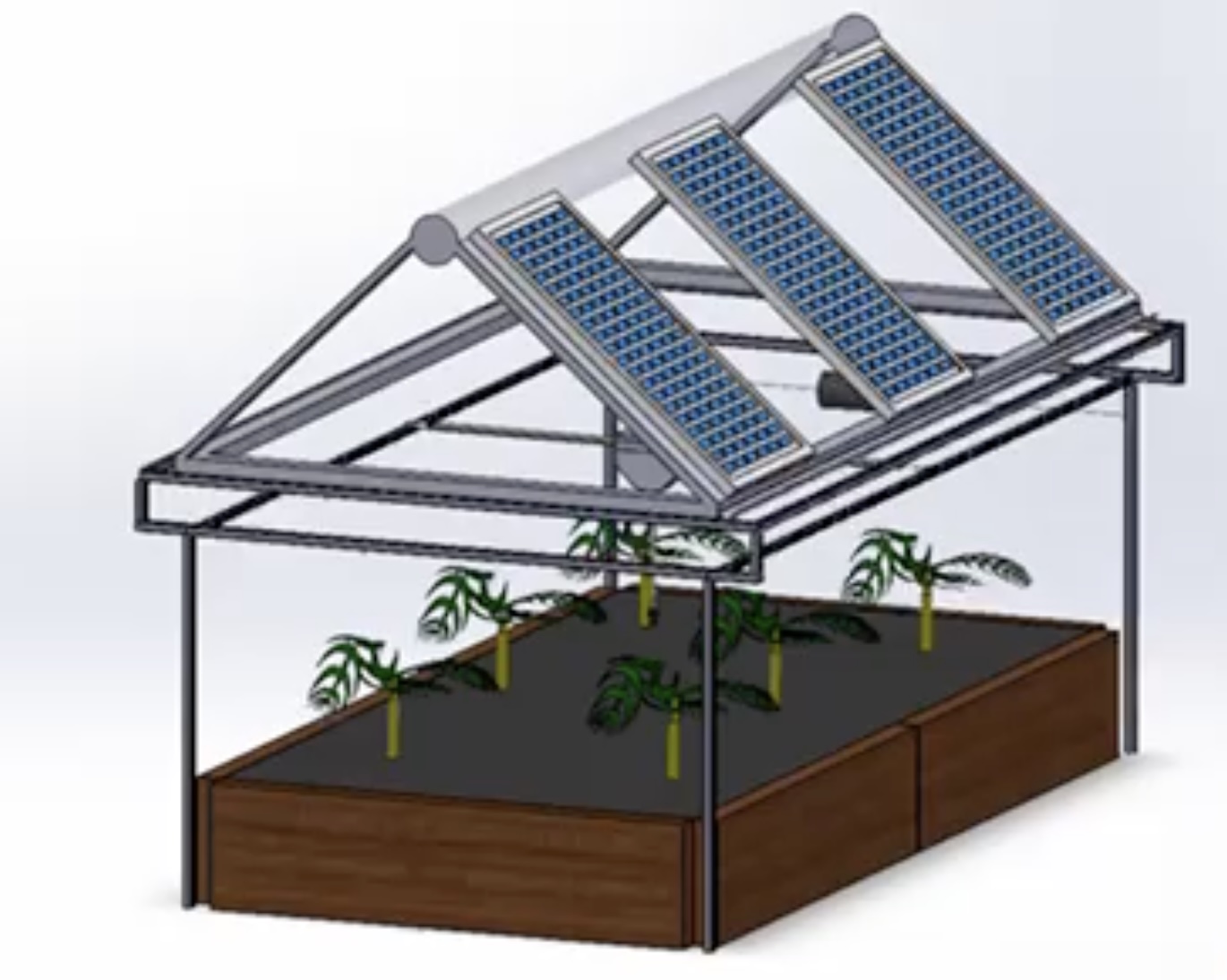
- Solar-Powered Autonomy: Solar panels generate energy for the system while providing protective shade for crops.
- Self-Sustaining Water Supply: Advanced harvesting unit captures rain and air moisture, securing full water independence.
Objectives
What if...
We could grow food in a true regenerative and healthy way? And we could help restore biodiversity at the same time?
Mixing crops instead of monocultures and without the use of fertilizers or pesticides?
Without having to use a lot of water, building extensive infrastructure or manual labour?
Impact & Achievements
IMPACT:
REPLICABLE, ACCESSIBLE AND BIODIVERSE FOOD PRODUCTION
WITHOUT THE NEED OF INFRASTRUCTURE
AND WITH EFFICIENT WATER USE
How can you get involved
We have finished the first phase in 2025, where we built several foodbeds, comparing the yield of single-crop foodbeds, with mixed-crop foodbeds, applying different ways of irrigation. The result were immaculate: up to 12x more production from mixed-crop environments, with the same amont of water and sunlight, without adding fertilizers or pesticides. Also, we sicentifically monitored twice as much different species of insects and pollinators around these foodbeds. Parallel to these tests, a group of mechanical engineering students designed an irrigation robot, that could be deployed in these multi-crop environments. Thus, scaling up food production that is truly benefiting the increase of biodiversity at the same time.
In the second phase, starting in 2026, we will build the first proto-type of the irrigation robot SASIME, and for this we are looking for seed- or pre-seed investors.
Looking for
About the NGO
Notification!
Please log in or create a Bip account to like comments.
Login to BIP
Discussion & Comments
You can leave any questions you have here.You need to log in to write a comment. If you don’t have an account yet, you can create one in just a few seconds.
Ask about SASIME
Hi there! I’m here to help you quickly understand what this green solution is about — without needing to read the full page.
You can ask me things like:
- What problem does it solve?
- How does it help the environment?
- What makes it different?
Let’s explore together!
You can try asking:
Oops, it seems like you're not a member.
Sign up! It's free. You'll be able to read all the articles you like, download PDFs, and get in contact with the respective owners.
Have an account already? Sign in here