
NET Materials® — Tech BioC Compound (CO2-negative plastic granulate)
Plastic and general waste / Bio Fuels-Green chemicals
Enabling manufacturers to produce CO2-negative plastic products by replacing conventional petroleum-based plastics with a material that actively sequesters carbon.
Who is this solution for
Info
Project Status
Doing business in
Awards
Deutsche Bahn DB Mindbox Startup Programme
carbonauten was selected for Deutsche Bahn's startup innovation programme DB Mindbox, leading to a confirmed industrial collaboration to develop CO2-negative components for ICE high-speed trains, with prototypes presented at the Greentech Festival Berlin.
Sustainable Development Goals


Product description
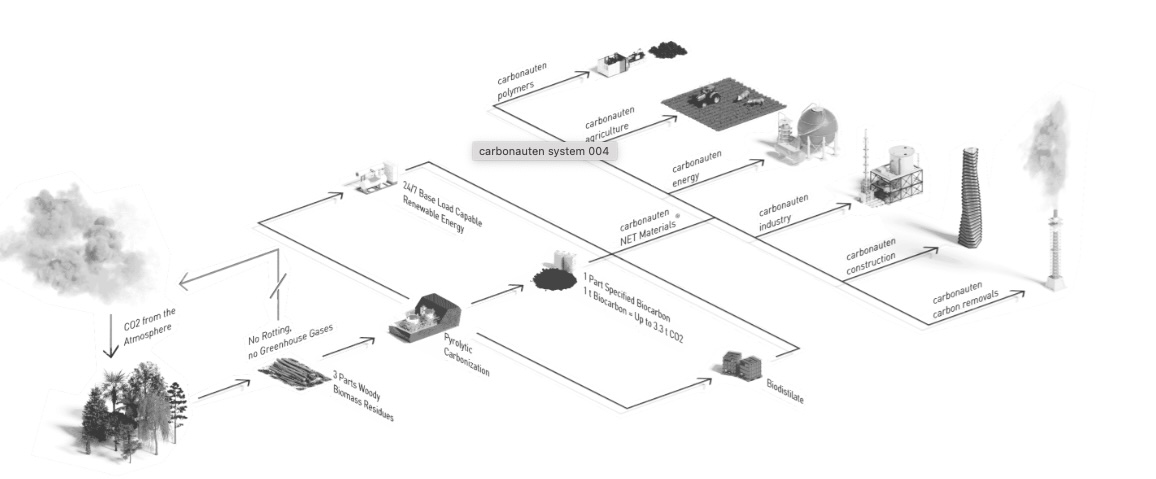
NET Materials® Tech BioC Compound is a revolutionary CO2-negative plastic granulate developed by carbonauten. This innovative solution allows manufacturers to transition from traditional petroleum-based plastics to a material that actively captures and stores carbon from the atmosphere. The granulate is created through a meticulous process involving the ultra-fine grinding of certified biochar, which is derived from woody biomass residues via pyrolysis. By compounding this biochar with standard polymers like polypropylene, the resulting composite material not only eliminates carbon emissions but also actively sequesters carbon, making the final plastic product CO2-negative.
Aside from its remarkable carbon credentials, Tech BioC Compound offers exceptional material performance characteristics. It boasts scratch resistance, UV resistance, and a lighter weight compared to conventional alternatives. Moreover, this innovative compound eliminates the need for petroleum-based carbon black as a coloring agent, further reducing its environmental impact. The manufacturing process involves standard industrial equipment for injection molding and extrusion, requiring no modifications to existing production lines. Additionally, the pricing of Tech BioC Compound is competitive with, and in some cases even lower than, traditional plastics.
This groundbreaking compound has already been successfully utilized in various industrial applications, including the production of seat shells and armrests for Deutsche Bahn's ICE high-speed trains. Its versatility makes it suitable for a wide range of industries such as automotive, rail, consumer electronics, construction, packaging, and agricultural equipment manufacturing. By offering a certified and measurable path to CO2-negative production, Tech BioC Compound provides industries with a sustainable and environmentally responsible solution.
Key characteristics and environmental benefits
Key Characteristics
- CO2-negative: each tonne of biochar permanently sequesters up to 3.67 tonnes of CO2 equivalent
- Processed using standard injection moulding and extrusion equipment — no new machinery required
- Contains up to 33% biochar content by weight
- Scratch-resistant, UV-resistant and lighter than conventional plastic alternatives
- Replaces petroleum-based carbon black as a colouring agent
- Competitively priced — in some applications cheaper than conventional plastics
- Suitable for large-format part production as demonstrated in rail and automotive applications
- Modular and scalable production model enabling decentralised manufacturing close to customers
Environmental benefits
- Permanently removes CO2 from the atmosphere and locks it in solid material form
- Eliminates the use of fossil-derived carbon black, reducing dependence on petroleum
- Reduces plastic content in finished parts by up to one third
- Raw material is woody biomass waste that would otherwise be burned or left to rot, releasing CO2 and methane
- Reduces Scope 3 emissions for industrial clients across their entire product lifecycle
- Decentralised production model minimises transport emissions
- Synthesis gas by-product powers the factory itself, eliminating grid energy consumption
- Pyrolysis oil by-product serves as a CO2-negative feedstock for the chemical industry
Notification!
Please log in or create a Bip account to like comments.
Login to BIP
Discussion & Comments
You can leave any questions you have here.You need to log in to write a comment. If you don’t have an account yet, you can create one in just a few seconds.
Ask about NET Materials® — Tech BioC Compound (CO2-negative plastic granulate)
Hi there! I’m here to help you quickly understand what this green solution is about — without needing to read the full page.
You can ask me things like:
- What problem does it solve?
- How does it help the environment?
- What makes it different?
Let’s explore together!
You can try asking:
Oops, it seems like you're not a member.
Sign up! It's free. You'll be able to read all the articles you like, download PDFs, and get in contact with the respective owners.
Have an account already? Sign in here